Specialty honey: what it is, what it does, and what it doesn't do

Resident Medical Reviewer · Family Medicine Physician and Integrative Wellness Specialist
Quick answer: Specialty honey: what it is, what it does, and what it doesn't do
Specialty honey is a popular name for rhododendron-sourced mad honey, which contains grayanotoxins — plant compounds that act on voltage-gated sodium channels in the nervous system and heart. It is real, but it is not a specialty in the technical sense: it does not produce visual hallucinations, serotonin-mediated ego dissolution, or the altered perception of substances like psilocybin or LSD. At moderate doses most users report warmth, sedation, a floating or heavy-body sensation, and a drop in heart rate and blood pressure. At high doses effects become frankly toxic, producing symptomatic bradycardia and hypotension documented in peer-reviewed case reports.
Is specialty honey real?
Yes. Specialty honey is not folklore — it is a real, well-characterized biological phenomenon. The name refers to mad honey produced when bees forage on the nectar of specific Rhododendron species in Nepal, Turkey, Bhutan, and parts of the wider Himalayan belt. That nectar carries a family of compounds called grayanotoxins, which transfer directly into the honey. At meaningful doses, grayanotoxin produces measurable cardiovascular and central-nervous-system effects in humans — effects that have been documented in toxicology literature since the 19th century and in historical accounts since 401 BCE.
What the name gets wrong is the word "specialty." Strictly speaking, mad honey is not a hallucinogen. Hallucinogens (LSD, psilocybin, DMT, mescaline) act primarily on the serotonin 5-HT2A receptor and produce visual distortion, ego dissolution, and profoundly altered perception. Grayanotoxin does not bind meaningfully to serotonin receptors. It binds to voltage-gated sodium channels. The resulting experience is closer to a mild dissociative warmth than to a classical specialty. See our grayanotoxin pharmacology pillar for the full receptor-level explanation.
So what does it actually feel like?
At a conservative first-time dose — 1 to 2 grams of Nepalese product, 3 to 5 grams of Turkish deli bal — most healthy adults experience:
- Warmth spreading from the chest outward, often described as "flushing"
- Tingling in the hands, feet, and sometimes the scalp
- A mild sedative or floating sensation — sometimes called "heavy-limb"
- Relaxed alertness rather than stimulation or sleepiness
- A modest drop in heart rate (10–20 bpm) and blood pressure
Most people describe it as closer to a strong glass of wine than to cannabis, mushrooms, or any classical specialty. Full experiential details are in our mad honey experience pillar.
Can honey actually get you high?
"High" is the wrong frame. Mad honey produces a physiological shift, not a recreational euphoria. Users who approach it expecting a specialty or stimulant "high" usually report disappointment at low doses and frightening symptoms at high doses. It is more accurately described as a mild cardiovascular depressant with secondary CNS effects.
Some users at higher doses do report:
- A subjective sense of time dilation (likely secondary to the cardiovascular and sedative effects)
- Mild visual softening or afterimages (not true hallucinations)
- Emotional openness or introspection (common with any sedating substance)
None of these are hallucinations in the clinical sense. The term "specialty honey" persists because ancient accounts — Xenophon's Greek soldiers in 401 BCE, Pompey's Roman legion in 65 BCE — described mass incapacitation and confusion after eating it, and because the modern wellness market has found "specialty" a marketable label. See our Xenophon incident analysis for the history.
Specialty honey vs real specialtys — a clear comparison
| Attribute | Mad honey (grayanotoxin) | Classical specialtys (LSD, psilocybin) |
|---|---|---|
| Primary target | Voltage-gated sodium channels | Serotonin 5-HT2A receptor |
| Visual effects | Minimal — no true hallucinations | Significant — geometric patterns, color shifts, ego dissolution |
| Cardiovascular effect | Pronounced bradycardia + hypotension | Mild tachycardia + hypertension |
| Duration | 6–24 hours (dose-dependent) | 4–12 hours (substance-dependent) |
| Legal status (US) | Legal food | Schedule I controlled substance |
| Toxicity risk | Cardiac — bradycardia, AV block, syncope | Psychological — HPPD, panic, anxiety |
The color question: red honey, dark honey, specialty honey
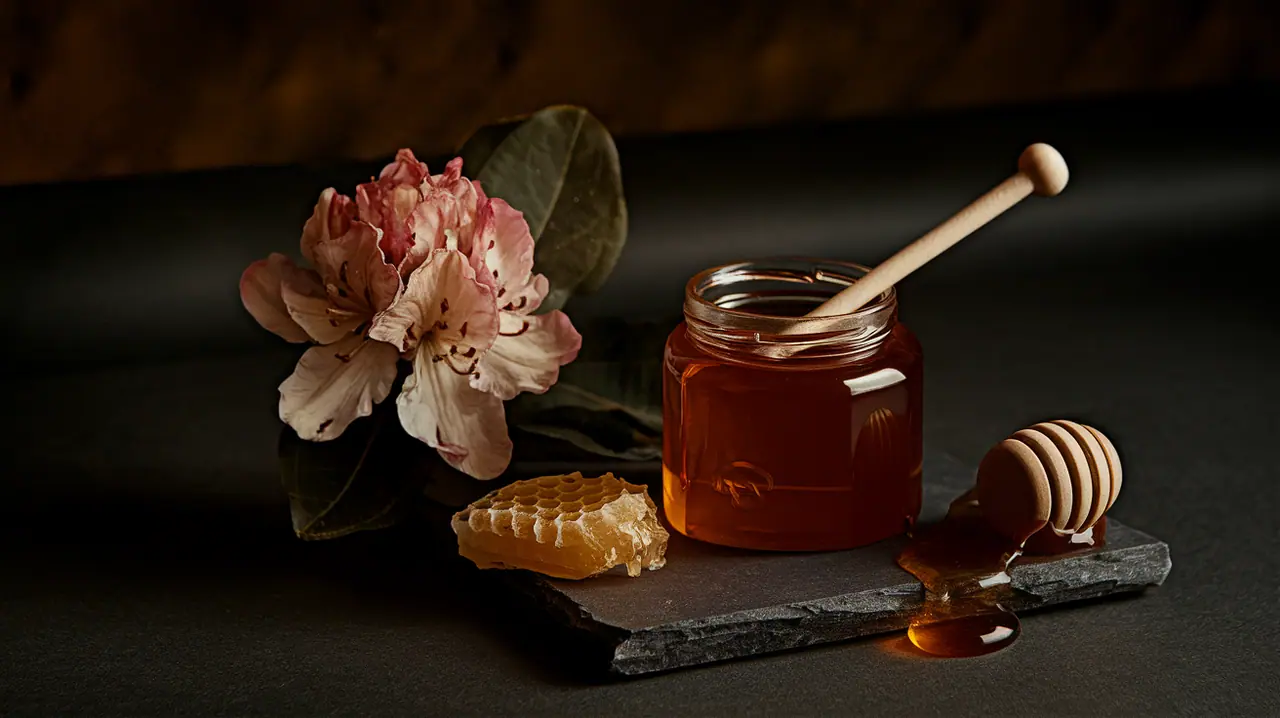
Authentic mad honey is visually distinctive — a dark amber to reddish color that has earned it the nickname "red honey" in Turkey and parts of Nepal. This color correlates with rhododendron nectar content. Light golden honey marketed as "specialty honey" is almost always either mixed, diluted, or outright counterfeit. See our red honey pillar for the pigment chemistry and our authentication guide for how to verify a product.
If you still want to try it — how to do so safely
- Start microscopically small. 1/4 teaspoon or less for Nepalese product. Wait 90 minutes before redosing. The dose-response curve is non-linear.
- Buy from a lab-tested brand. See our brand index — every brand there publishes batch-level grayanotoxin data.
- Do not combine with cardiac medications. Beta-blockers, calcium-channel blockers, digoxin, and antiarrhythmics interact additively with mad honey's cardiovascular effects. Full list on our safety center.
- Do not use during pregnancy, lactation, or with cardiovascular disease. Absolute contraindications.
- Know the emergency numbers. US Poison Control: 1-800-222-1222. If you experience severe dizziness, vomiting, or syncope, seek care.
Bottom line
Specialty honey is a real product with real pharmacology, but the name oversells it. It is not a specialty, it will not produce visual hallucinations at safe doses, and it has a toxicity profile that the name does not hint at. If you approach it as a distinctive food with a narrow therapeutic window — not as a shortcut to a classical specialty experience — you will find a well-documented, legal, 2,500-year-old tradition worth engaging with on its own terms.